

By: Dr. Venus Oliva Cloma-Rosales
2025 Eisenhower Fellow | #EFJourney
Over the last few years, Health AI has moved from promise to presence. Predictive models are now embedded in clinical workflows, large language models are shaping how patients seek health information, and data-driven tools increasingly inform decisions at both bedside and policy levels.
Yet alongside this rapid adoption, a deeper question has become unavoidable:
Are our health systems actually learning, or are we simply automating faster?
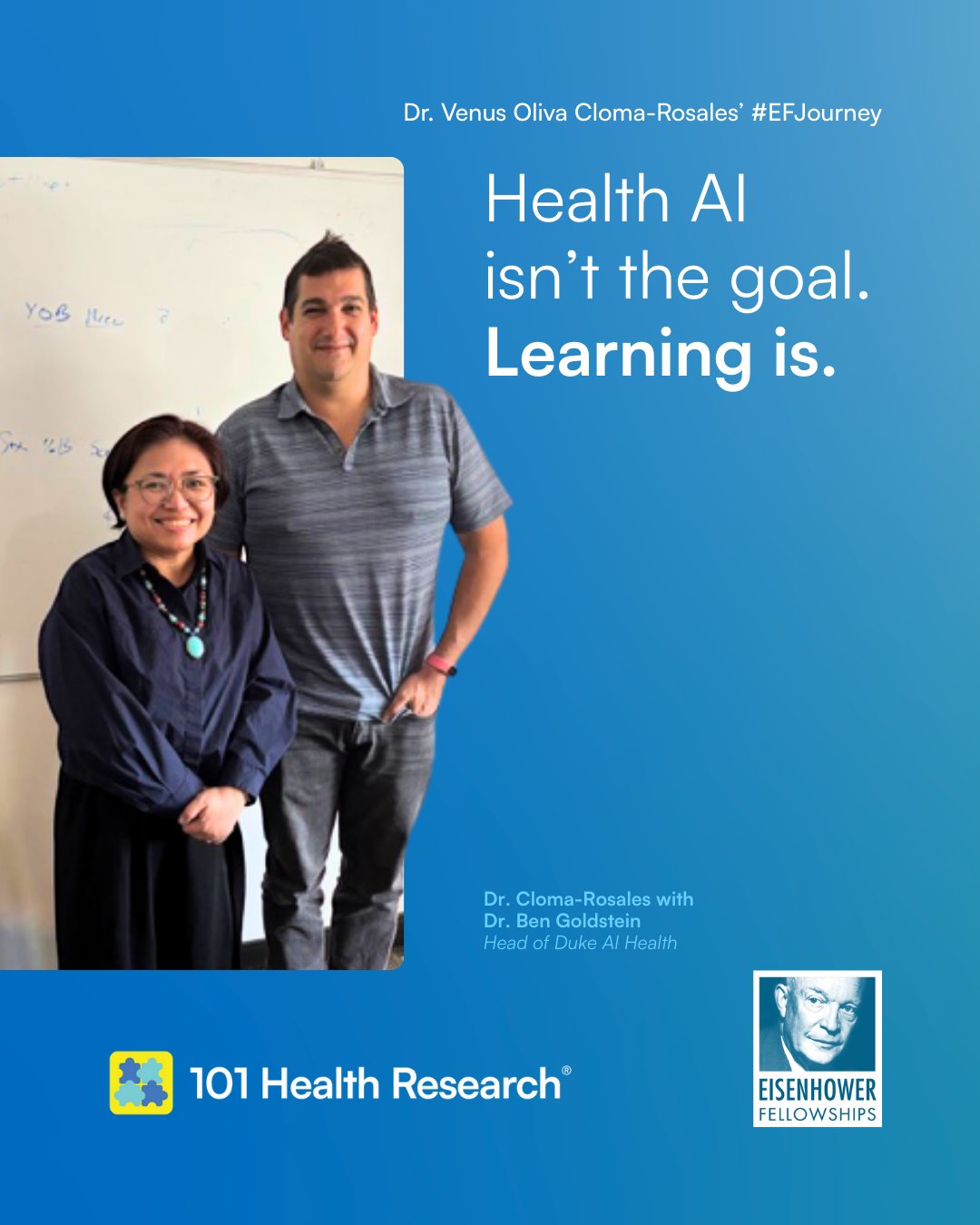
Over the past year, our global engagements and academic exchanges have reinforced the importance of anchoring Health AI within a Learning Health System framework, and of treating research integrity as a living practice, not a static requirement. These reflections were shaped in particular by my exchange with Duke University and Duke AI Health, where Health AI is approached not as a product layer, but as a system-level learning capability.
Learning Health Systems as the Necessary Frame
A Learning Health System (LHS) is not defined by advanced analytics or AI maturity. It is defined by intent and design.
In a Learning Health System:
-
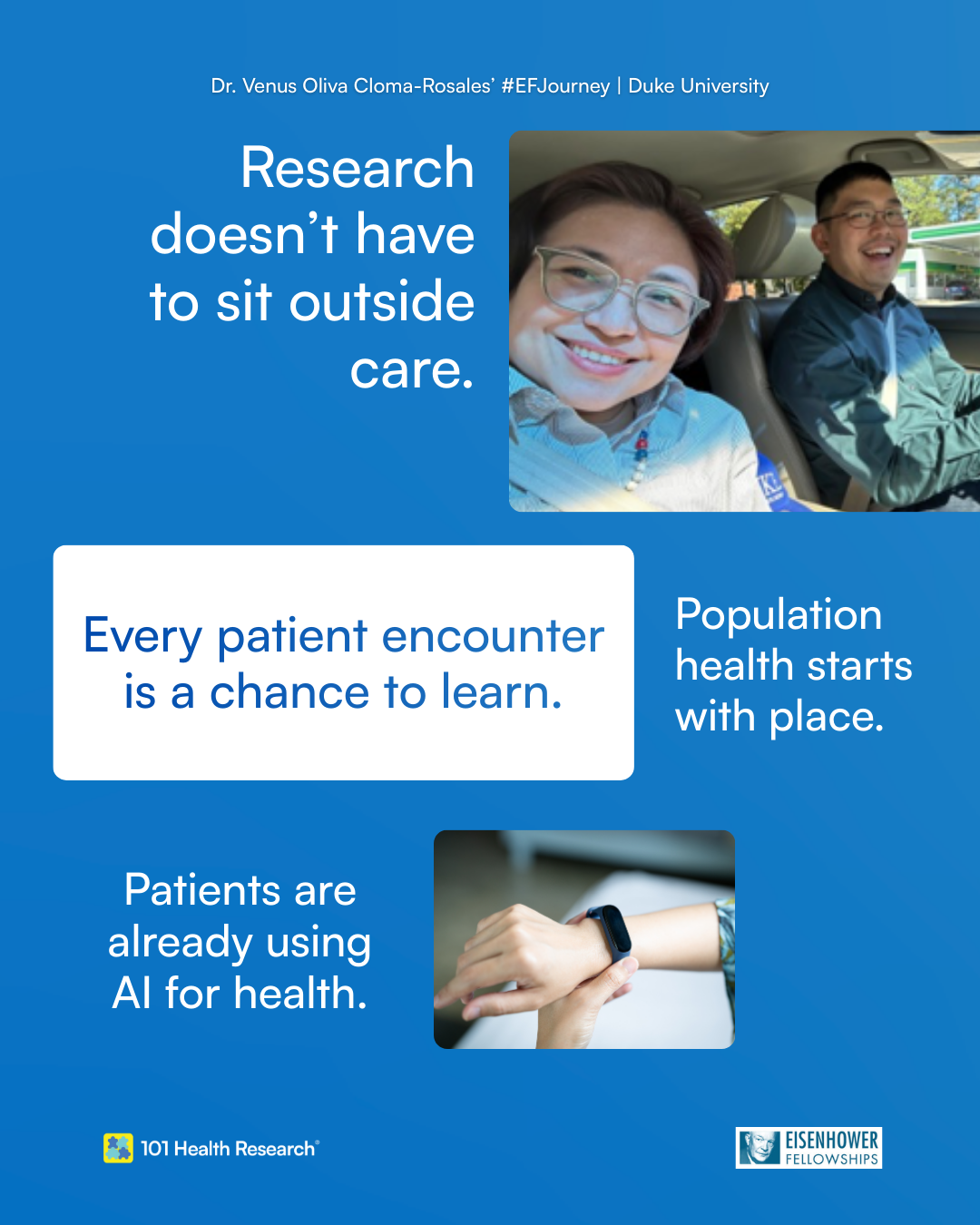
- Every patient encounter becomes an opportunity to learn
-
- Insights are deliberately fed back into care
-
- Interventions are evaluated in real-world settings
-
- Systems adapt continuously, not episodically
Technology enables this—but does not guarantee it.
This framing was especially evident during engagements with Duke AI Health, where Health AI is treated not as an add-on, but as integral to how a health system learns, evaluates itself, and improves over time.
At Duke, the question is rarely “Can we build this model?”
It is more often “What should the system be learning, and how will it act on that learning?”
Predictive Modeling: From Performance to Purpose
One of the most persistent challenges in Health AI research remains the overemphasis on model performance as an endpoint.
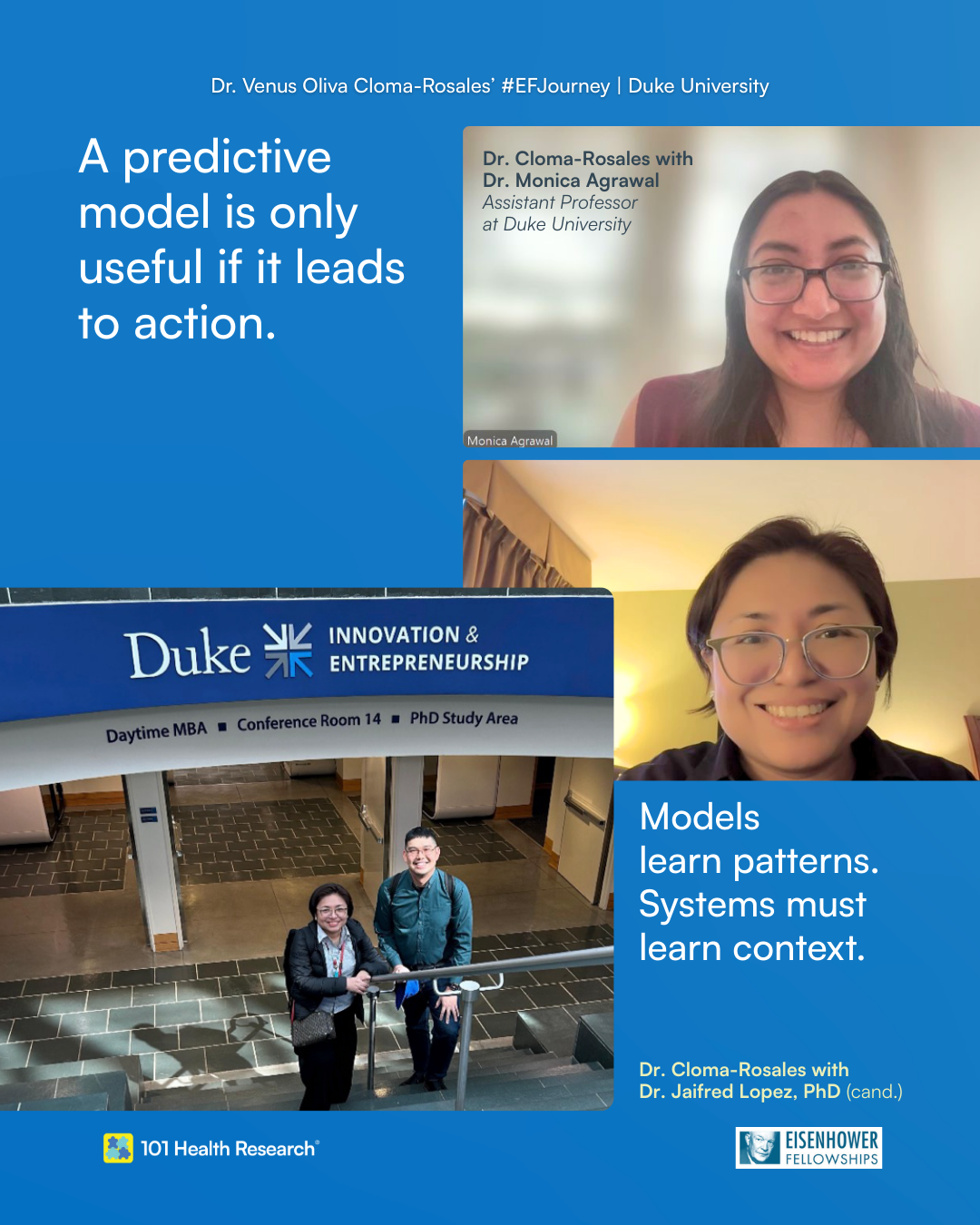
Within a Learning Health System, predictive modeling is a means to an end, not an end in itself. A model only becomes meaningful when:
-
- It is linked to a clear, feasible intervention
-
- That intervention can be delivered within system constraints
-
- Outcomes are measured and fed back into the system
This reframes a central research question for 2026:
Under what conditions do predictive models actually improve care, rather than simply describe risk?
For low- and middle-income countries (LMICs), where resources are finite and trade-offs are real, this question carries even greater weight. Prediction without action is not neutral; it can divert attention, effort, and trust.
Population Health, Place, and Structural Learning
Health AI also expands what is possible for population health learning, particularly when EHR data is linked with geographic and social drivers of health.
At institutions like Duke, geocoding and contextual data allow systems to see how health outcomes are shaped by place, access, and structure—not just clinical variables.
This raises a new set of research and integrity questions:
-
- How do population health models perform across different social and geographic contexts?
-
- When does stratification reduce inequity, and when might it reinforce it?
-
- How do we validate models when the “ground truth” itself is uneven?
These are not purely technical questions. They are methodological, ethical, and policy-relevant.

Comparative Effectiveness Inside the Learning Loop
Learning Health Systems increasingly blur the boundary between research and practice.
Comparative effectiveness work now spans:
-
- Retrospective real-world analyses
-
- Prospective observational learning
-
- And, in some settings, clinical trials embedded directly into routine care
- And, in some settings, clinical trials embedded directly into routine care
This evolution—seen clearly in mature academic health systems like Duke—offers enormous potential, but also raises important integrity considerations:
-
- How do we preserve rigor when research is embedded in care?
-
- What constitutes adequate transparency and consent?
-
- How do we govern learning activities that affect patients in real time?
These questions become more complex, not less, as AI tools are layered into clinical decision-making.
Foundation Models and the Question of Transferability
Large foundation models, particularly language models, introduce both scale and risk.
These models learn rules, schemas, and relationships across vast datasets, including the language of patient encounters. Yet healthcare meaning often lives in unstructured narratives—clinical notes, incomplete histories, and emotionally charged questions.
Recent discussions with Duke AI Health researchers highlighted a critical issue for global health systems:
What happens when models trained in one health system are deployed in another?
For LMIC contexts, this is not a future concern—it is a present one. External validity, bias propagation, and contextual mismatch are central research integrity challenges that demand proactive study.

Patient-Facing AI: Studying Reality, Not Assumptions
One of the most important shifts in recent Health AI research—exemplified by work at Duke AI Health—is the move toward studying how patients actually use AI, rather than how we assume they will.
Large-scale analyses of real patient–LLM interactions reveal patterns that are deeply human:
-
- Incomplete or ambiguous clinical context
-
- Affective language and anxiety
-
- Leading questions that induce model agreement
-
- Reinforcement of misconceptions through decontextualized facts
This reframes another core research question:
How should we evaluate safety, accuracy, and harm when AI systems act as communicators, not just information retrievers?
Answering this requires interdisciplinary methods and a rethinking of what “responsible deployment” truly means.

Research Integrity as a Continuous Practice
Across predictive modeling, population health, foundation models, and patient-facing AI, one theme is consistent:
Research integrity can no longer be treated as a checklist.
In the era of Health AI and Learning Health Systems, integrity must be:
-
- Continuous, not episodic
-
- Embedded in workflows, not appended at publication
-
- As much about governance and reflexivity as about methodology
Integrity becomes a practice of learning responsibly—especially as systems evolve faster than guidelines.
I am especially grateful for the generosity and intellectual openness of Prof Ben Goldstein, Dr Jaifred Lopez, and Dr Monica Agrawal of Duke University, whose work at Duke AI Health exemplifies what it means to build systems that learn responsibly.
Looking Ahead: A Research Agenda for 2026
As we move through 2026, the most important contribution of Health AI research may not be new tools, but better questions:
-
- When does AI accelerate learning—and when does it obscure it?
-
- How do we design systems that learn across contexts, not just within them?
-
- What does rigorous real-world evaluation look like at scale?
-
- How do we ensure that innovation strengthens, rather than erodes, trust?
At 101 Health Research, we see Health AI, Learning Health Systems, and research integrity as inseparable. Our work moving forward will continue to sit at this intersection—drawing from global exemplars like Duke AI Health, while remaining grounded in the realities of diverse health systems.
Learning, after all, is not automatic. It must be designed for.


